01 Safety Alert: The Overlooked Slip-and-Fall Risks in Home Environments
Slippery areas in home environments have always been “invisible killers” in our daily lives. Especially in special areas like bathrooms, kitchens, and poolside, traditional floor mats often fail to provide lasting anti-slip protection.
In modern home decoration, most people focus on the aesthetics and durability of flooring but overlook the important safety detail of floor mats. Many households still use old PVC mats, whose coefficient of friction decreases significantly in wet conditions, dropping from 0.6-0.9 in dry state to 0.4-0.7 in wet state.
Especially for families with elderly members, children, or pregnant women, choosing a truly safe and reliable anti-slip mat becomes crucial.
According to relevant data, nearly 70% of home slip-and-fall accidents occur in bathroom and kitchen areas, and a considerable portion of these accidents could be prevented by using professional anti-slip products.
02 Material Revolution: The Essential Difference Between TPE and PVC
Why has TPE material become the preferred choice for high-end anti-slip floor mats? This stems from the molecular structure and physical properties of the two materials.
TPE (Thermoplastic Elastomer) is essentially a modified product of styrene-butadiene-styrene triblock copolymer. Its molecular chain has a special “hourglass” structure—the hard styrene segments provide support, while the soft butadiene segments impart elasticity.
This structure allows TPE to maintain elasticity within a wide temperature range of -50°C to 120°C. It can be injection-molded without vulcanization, providing excellent physical properties for products.
In contrast, traditional PVC material is a thermoplastic plastic polymerized from vinyl chloride monomers, with linear molecular chains.
To enhance flexibility, 40%-60% plasticizers must be added during the production process. These small molecules migrate over time, causing the mat to gradually harden and become brittle.
More critically, some low-cost PVC mats may contain excessive amounts of phthalate plasticizers. EU REACH regulations strictly limit the content of such substances to no more than 0.1%, but market sampling shows that over 23% of low-cost PVC anti-slip mats exceed this limit by more than three times.
03 Performance Showdown: Comprehensive Comparison Across Six Dimensions
In terms of anti-slip performance, TPE material shows clear advantages. Laboratory test data indicates that TPE mats can achieve a coefficient of friction of 0.8-1.1 in dry conditions, and still maintain 0.7-1.0 under simulated wet bathroom conditions.
Particularly important is that even under extreme slippery conditions after applying shower gel, TPE mats can achieve a coefficient of friction of 0.65, while PVC mats drop sharply to 0.38—a difference of nearly double in protective effectiveness.
TPE materials also outperform in environmental safety. A 72-hour sealed test showed that formaldehyde emissions from TPE mats are far below national standards, while some PVC mats may detect harmful substances such as phthalates.
Regarding antibacterial performance, TPE mats with added silver ion antibacterial agents can achieve a 99.6% inhibition rate against E. coli, while PVC mats typically show about a 40% decrease in antibacterial effect due to lower porosity.
Durability tests also confirm the superior performance of TPE. After 1000 hours of accelerated aging at 85°C/85% RH, TPE mats retained up to 89% of their tensile strength, while PVC mats retained only 62% due to plasticizer evaporation.
Taber abrasion tests showed that the wear amount of TPE mats was only 0.08g/1000 revolutions, nearly twice as wear-resistant as PVC mats (0.15g/1000 revolutions).
04 Installation Case Study: Full Analysis of Professional Pool Mat Installation
Taking an indoor heated swimming pool mat installation project as an example, the total area is approximately 800 square meters, covering the pool body and surrounding areas (including locker rooms, shower areas, and walkways).
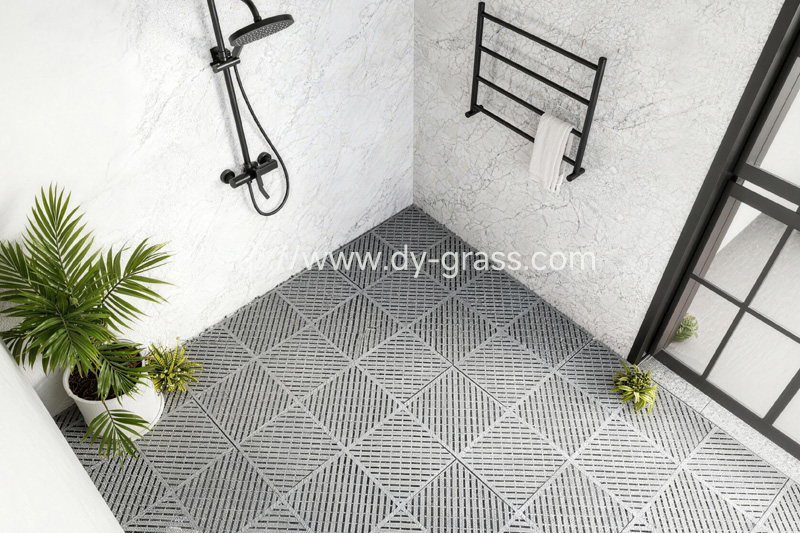
Traditional pool mat installation often faces challenges such as uneven ground, poor drainage, and mat displacement. DYG Anti-Slip TPE Interlocking Floor Mats adopt a modular design with individual tile specifications of 300×300×10mm, allowing flexible cutting and splicing according to actual site conditions.
Before installation, we thoroughly cleaned and dried the ground, ensuring the base levelness error did not exceed 3mm/2 meters.
For curved areas at pool edges, we used a radial cutting method to ensure perfect pattern alignment and avoid uneven seams.
During installation, we paid special attention to drainage slope design, maintaining a 0.5%-1.0% slope toward drainage channels to effectively prevent water accumulation.
For high-humidity areas like shower zones, we used an open-grid interlocking design. This structure not only facilitates easy removal and cleaning but also ensures secure mat fixation through buckle-type connections.

05 User Testimonials: From Skepticism to Trust
“Initially, I also thought regular mats were sufficient, until an elderly family member actually slipped in the bathroom,” recalled Ms. Wang. “After that incident, I immediately ordered DYG Anti-Slip TPE Floor Mats.”
Ms. Wang’s bathroom is an older layout without complete dry-wet separation, making it easy for water to splash onto dry floor areas. After switching to DYG Anti-Slip TPE Floor Mats, she found that even when the floor was wet, she could feel support underfoot—unlike traditional PVC mats that feel “slippery.”
What surprised her more was that the grid structure on the bottom of the mat effectively provides ventilation and moisture prevention. After showering, no water accumulates or mold grows underneath, and drying time is nearly twice as fast as before.
Another user, Mr. Zhang, shared his experience using DYG Anti-Slip TPE Floor Mats around his family pool: “Even when children run barefoot, the mats don’t shift. The anti-slip effect truly meets commercial standards.”
Professional institution tests show that high-quality TPE mats can achieve anti-slip ratings of R9-R10, approaching professional pool requirements.

06 Purchasing Guide: How to Identify Truly High-Quality TPE Floor Mats
Faced with numerous mat products on the market, how can you select genuine high-quality TPE mats? Here are key criteria:
First, examine the material. Using a lighter to burn the mat edge provides preliminary identification—TPE burns without black smoke, and drips can form threads; PVC burns with black smoke, produces pungent odors, and drips tend to crumble.
Second, check the thickness. Standard TPE mat thickness variation should be less than 0.5mm. Some low-cost products labeled as 10mm thick may measure only 5.2mm, reducing anti-slip performance by nearly 35%.
For products with suction cup designs, choose those with bottom suction cup diameters no less than 8mm and spacing no more than 15mm. Research shows this design achieves adsorption force up to 0.3N/mm², far exceeding PVC mats’ 0.15N/mm².
Environmental certifications are also important references. High-quality TPE mats should have authoritative certifications like China’s Ten Rings certification and EU CE certification. For food contact scenarios, they should also have US FDA food-grade certification.
Finally, judge by odor—new mats should have a slight rubber smell that dissipates within 24 hours. Persistent pungent odors likely indicate excessive plasticizers or solvents.
With advancements in materials science, TPE materials are leading a new trend in anti-slip floor mats. Professional test data shows that TPE mats’ coefficient of friction in wet conditions is nearly double that of traditional PVC products.
DYG Anti-Slip TPE Floor Mats not only address core home safety concerns but also perfectly integrate safety protection with spatial aesthetics through freely interlocking designs.
As more families choose to install these material mats at bathroom entrances, they’re purchasing not just a mat, but safety protection for every step their family takes.
Post time: Jan-07-2026